Choosing from the many flooring options in Kenya is one of the most consequential decisions in any interior project. The floor covers every square metre of your living space, takes more daily punishment than any other surface, and sets the visual tone for the entire room. Get it right and the home looks and feels completely different. Get it wrong and no amount of paint or furniture will fix it.
This 2026 guide compares every major flooring option available in Kenya including SPC, ceramic tiles, porcelain, hardwood, engineered wood, vinyl, and carpet. It covers the full range of flooring options in Kenya including durability, cost, maintenance, and which choice is genuinely best suited to each room and situation.
Why Flooring Choice Matters More in Kenya Than Most People Realise
Flooring decisions in Kenya carry practical dimensions that don’t apply in many other climates. Nairobi’s dust, the humidity variation between highland and coastal regions, the heavy foot traffic of large households, and the temperature swings between seasons all place real demands on floor surfaces. Many flooring options in Kenya that appear affordable upfront can warp, crack, fade, or become a maintenance headache within a few years if they are not suited to the local climate.
Cost is also a more layered question than it first appears. The cheapest flooring option per square metre is rarely the cheapest over a ten year period once you factor in maintenance, replacement, and the ongoing effort of keeping it presentable. The best flooring options in Kenya balance upfront cost, real world durability, ease of maintenance, and the visual quality that makes a space genuinely enjoyable to live in.
Strofix Tip: The single most important question to ask about any flooring option is not “how much does it cost per m²?” but “how will this look and perform in three years with daily use in Kenya?” That question changes most people’s decision entirely.
Flooring Options in Kenya Comparison (2026)
The table below summarises the key metrics across all major flooring options in Kenya. Detailed breakdowns for each option follow.
| Flooring Type | Cost Range (KES per m²) | Expected Lifespan | Best Rooms | Maintenance |
|---|---|---|---|---|
| SPC Flooring | 1,800 – 3,500 | 15 – 25 years | All rooms | Very low |
| Ceramic Tiles | 900 – 2,200 | 20 – 30 years | Kitchen, bathroom, outdoor | Low (grout upkeep) |
| Porcelain Tiles | 1,800 – 5,000+ | 25 – 40 years | Living areas, bathrooms, outdoor | Very low |
| Hardwood (solid) | 4,500 – 9,000+ | 30 – 50 years (with refinishing) | Bedrooms, formal living rooms | High |
| Engineered Wood | 2,800 – 5,500 | 15 – 25 years | Bedrooms, living rooms | Medium |
| Vinyl (LVT / LVP) | 1,200 – 2,800 | 10 – 15 years | Rentals, offices, high-traffic areas | Low |
| Carpet | 800 – 2,500 | 5 – 10 years | Bedrooms (with reservations) | High |
Every Major Flooring Option for Kenyan Homes, Explained
1. SPC Flooring ; The Best All Round Option for Kenya in 2026
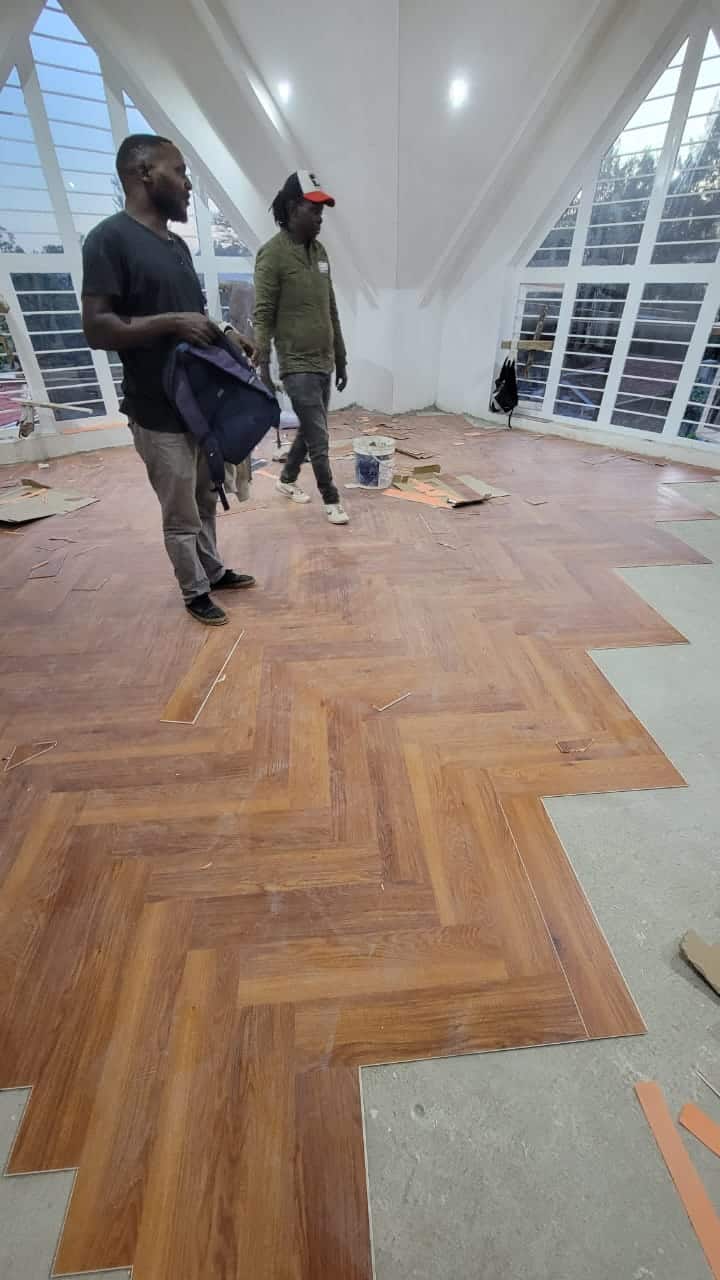
Stone Plastic Composite (SPC) flooring has emerged as the dominant flooring choice for Kenyan homes over the last three years, and for good reason. Its core is made from a highly compressed mix of limestone powder and PVC stabilisers, a key reason it outperforms many other flooring options in Kenya’s variable climate in terms of dimensional stability. SPC does not expand, contract, warp, or buckle with humidity changes which is a critical advantage in Nairobi, Mombasa, and highland areas where other floor types frequently fail.
The wear layer on quality SPC flooring resists scratches, scuffs, and the grit that degrades softer flooring types quickly in Kenya’s dusty environment. It is 100% waterproof, making it suitable for kitchens and utility areas as well as living rooms and bedrooms. Installation uses a click-lock floating system that sits directly over a prepared subfloor with no adhesive or curing time and a room can be installed and walked on the same day.
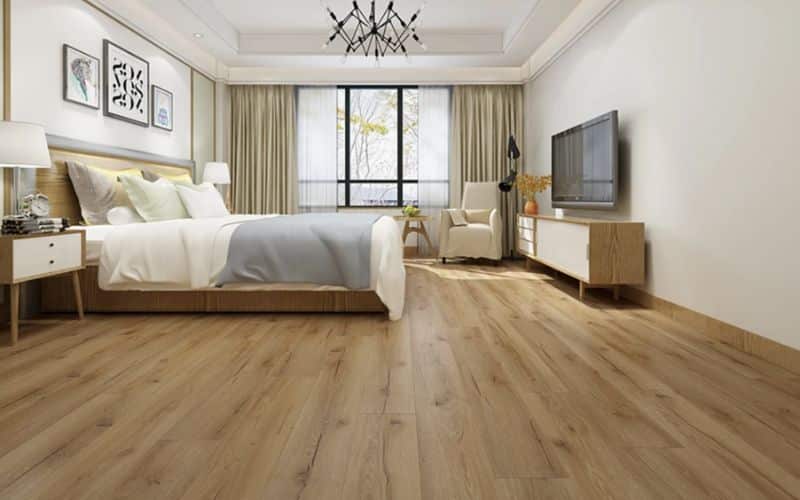
Visually, premium SPC flooring is indistinguishable from real hardwood to most observers. The embossed texture and grain patterns on quality products replicate the look and feel of oak, walnut, ash, and teak without any of the maintenance those species demand. For a full breakdown of options and pricing, visit our SPC Flooring Installation Services in Kenya page.
Verdict: SPC is the best flooring for Kenyan homes in 2026 where you want hardwood aesthetics with zero maintenance and maximum durability. It is the most frequently installed of all flooring options in Kenya that we handle, and the one we recommend as the default choice for bedrooms, living rooms, dining rooms, and home offices.
2. Ceramic Tiles; The Kenyan Classic
Ceramic tiles have been the default flooring choice for Kenyan homes for decades and they remain a sensible option in the right context. Fired clay with a glazed surface, ceramic tiles are hard, easy to clean, cool underfoot, and widely available across Kenya at a range of price points. They hold up well to heavy foot traffic and the abrasion from grit and dust that is a constant challenge in Nairobi.
The limitations of ceramic tiles are well established. They are cold underfoot in cool highland weather, unforgiving if you drop breakable items, and the grout lines between tiles accumulate dirt and require periodic maintenance to stay looking presentable. In living rooms and bedrooms, many homeowners find tiles less comfortable to live with long term compared to warmer floor surfaces. Ceramic tiles are best positioned as a practical, cost effective choice for kitchens, utility areas, outdoor terraces, and ground floor spaces where coolness and easy cleaning are the primary priorities.
3. Porcelain Tiles; Premium Durability for High-Traffic Spaces
Porcelain is a denser, harder, and less porous version of ceramic, fired at higher temperatures with finer clay. The result is a tile that is significantly more durable, more water resistant, and more resistant to staining than standard ceramic. Large format porcelain tiles in marble, stone, or concrete effects are now among the most popular flooring choices for living rooms and open-plan spaces in premium Kenyan homes, delivering a high-end look at a fraction of the cost of the natural materials they replicate.
The cost of porcelain flooring in Kenya is higher than ceramic but lower than genuine stone or hardwood, and the lifespan, when properly installed, can exceed forty years. The key practical consideration is that large format porcelain requires a perfectly flat, well prepared subfloor and professional installation to avoid cracking and lippage. Do not cut costs on installation; the tile quality will be wasted by poor workmanship.
4. Hardwood Flooring; Beautiful but Demanding in Kenya’s Climate
Genuine hardwood flooring remains the most aspirational flooring option for Kenyan homes. The warmth, depth, and character of real wood is something no manufactured product fully replicates. A well-maintained hardwood floor adds genuine value to a property and can last a generation with periodic sanding and refinishing.
The challenge in Kenya is the climate. Solid hardwood expands and contracts with changes in humidity and temperature. In Nairobi’s highland climate with significant seasonal variation, solid hardwood can gap in dry conditions and cup in wet ones if not properly acclimatised and installed. It also requires regular cleaning with wood-safe products, periodic re-oiling or re-sealing, and cannot be used in bathrooms, kitchens, or any wet area. For homeowners committed to genuine hardwood flooring in Kenya, professional installation with a full acclimatisation period and an ongoing maintenance plan is non-negotiable.
5. Engineered Wood Flooring; A Middle Ground Worth Considering
Engineered wood flooring uses a real hardwood veneer over a plywood or HDF core. The real wood surface gives it the authentic look and feel of solid hardwood, while the composite core makes it significantly more dimensionally stable and more resistant to humidity changes. It can be used in rooms where solid hardwood would be risky, though it remains unsuitable for bathrooms and high-moisture areas.
Engineered wood is a genuinely good option for Kenyan homes where the owner wants the aesthetic of real hardwood in a bedroom or formal living room but wants more reliability than solid hardwood provides. The key limitation is that the veneer layer can only be sanded once or twice before it becomes too thin to refinish, so the overall lifespan is shorter than solid hardwood.
6. Vinyl Flooring (LVT / LVP); Budget Friendly and Practical
Luxury Vinyl Tile (LVT) and Luxury Vinyl Plank (LVP) flooring occupy the segment just below SPC in terms of performance and price. Vinyl flooring is waterproof, comfortable underfoot, easy to install, and available in a wide range of wood and stone-effect designs. It is a popular choice for rental properties, offices, and budget home fit-outs in Kenya where the goal is a clean, presentable floor at minimum cost.
Cushion vinyl sheet flooring, widely known in Kenya as mkeka wa mbao, is a softer, roll-format variant of vinyl that is extremely common in rental properties, hostels, and budget residential fit-outs. It installs quickly, costs very little, and is comfortable underfoot, though it scuffs and tears more readily than rigid LVP or SPC. It remains one of the most widely used flooring options in Kenya for budget rental fit outs, though replacement every few years should be planned for.
The main difference between rigid vinyl and SPC is in the core. Vinyl’s flexible core is less dimensionally stable and less resistant to heavy furniture indentation than SPC’s rigid stone-composite core. For a home where durability over a decade or more is the goal, SPC represents better long-term value despite the higher upfront cost. For a rental property being fitted to a tight budget, good quality LVP or mkeka wa mbao is a sound and practical flooring choice in Kenya.
7. Carpet; Comfortable but Problematic in the Kenyan Context
Carpet traps dust, allergens, pet dander, and moisture more readily than any hard surface. In Nairobi’s dusty environment, carpet requires frequent and thorough vacuuming to remain hygienic, and it degrades visually faster than any other flooring option when not properly maintained. It is also the most vulnerable flooring in the event of water ingress, flooding, or persistent humidity which is a real risk in certain parts of Nairobi and in coastal areas.
Carpet does offer genuine comfort and acoustic softness that hard flooring cannot match, which is why some homeowners still request it for master bedrooms. If carpet is chosen for a bedroom in Kenya, invest in a quality synthetic fibre rather than wool, ensure the room is well ventilated, and plan for replacement within five to eight years. A better long-term alternative for bedroom comfort is SPC flooring paired with a quality area rug, which delivers softness where you want it while keeping the floor easy to clean.
How to Choose the Right Flooring for Each Room in Your Kenyan Home
- Living room and dining room. SPC in a warm wood tone or large format porcelain in a stone effect. Both are durable and easy to maintain. SPC is warmer and quieter; porcelain is cooler and harder-wearing under very heavy traffic.
- Master bedroom. SPC is the strongest recommendation as it is warm underfoot, silent, easy to clean, and available in tones that suit any bedroom colour scheme. Engineered wood is a premium alternative if budget allows.
- Children’s bedrooms. SPC is the clear winner because it is fully waterproof, scratch resistant, and easy to clean after spills and everything else children bring to a floor.
- Kitchen. Porcelain or ceramic tiles. Fully impervious to water, heat, and cooking spills. SPC can also be used in a kitchen if you prefer a warmer aesthetic; its waterproof core handles kitchen conditions well.
- Bathroom. Porcelain or ceramic tiles only. No wood based product belongs in a Kenyan bathroom, regardless of how waterproof the manufacturer claims it to be.
- Rental property. SPC or quality LVP. Fast to install, durable across tenancy changes, and presentable enough to command good rental rates without heavy maintenance overhead.
- Outdoor terrace or veranda. Outdoor rated porcelain or ceramic with an anti-slip rating. No indoor flooring product should be used in an exposed outdoor application in Kenya.
Which Flooring Lasts Longest in Kenya?
Porcelain tiles last longest in Kenya overall, with a lifespan of 25 to 40 years or more when properly installed. For warm living spaces and bedrooms, SPC flooring lasts 15 to 25 years with zero refinishing or special maintenance. These two options (porcelain for wet and high traffic areas, SPC for living spaces and bedrooms) cover virtually every room in a Kenyan home with a durable, low maintenance solution.
When homeowners ask us which flooring lasts longest across the widest range of rooms and conditions, the honest answer in 2026 is SPC for living spaces and bedrooms, and large format porcelain for kitchens, bathrooms, and outdoor areas. Between these two options, virtually every room in a Kenyan home is covered with a flooring choice that will look good, perform well, and require minimal ongoing effort for fifteen or more years.
The reason SPC has overtaken carpet and standard vinyl in our project portfolio over the last three years is straightforward: it solves the humidity and stability problem that makes solid hardwood a risk in Kenya, delivers better visual quality than ceramic tile in living spaces, and costs significantly less over ten years than the maintenance demands of real wood. Between SPC and porcelain, these are the two flooring options in Kenya where cost, aesthetics, durability, and ease of living align most convincingly.
How Strofix Interiors Handles Flooring Installation in Kenya
At Strofix Interiors, we supply and install all major flooring types including SPC, porcelain tiles, ceramic tiles, and engineered wood for flooring installation in Nairobi and throughout Kenya. Our process starts with a site visit to assess the existing subfloor condition, measure accurately, and discuss the right flooring option for each room’s use and the client’s aesthetic goals. We manage procurement, preparation, and installation under a single contract with one point of contact from start to finish.
For homes where flooring is part of a wider interior project alongside a gypsum ceiling, fitted wardrobe, and wall finishes, we advise on the full range of flooring options in Kenya before sequencing all trades to keep the project moving without delays or conflicts between contractors. Visit our SPC Flooring Installation Services in Kenya page for full details, or our guide to the Cost of Interior Design in Kenya for broader project planning guidance.
Ready to Choose the Right Flooring for Your Kenyan Home?
Get a detailed supply and installation quotation from Strofix Interiors. We cover SPC flooring, porcelain and ceramic tiles, engineered wood, and full room fit-outs across Nairobi and Kenya.
FAQs — Flooring Options for Kenyan Homes
What is the best flooring for a Kenyan home?
Among all the flooring options in Kenya, SPC is the best all-round choice for homes in 2026. It combines the warm aesthetics of hardwood with a waterproof, dimensionally stable core that handles Kenya’s climate without warping, gapping, or requiring ongoing maintenance. For kitchens and bathrooms, large format porcelain tiles are the strongest choice.
Which flooring lasts longest in Kenya?
Porcelain tiles have the longest lifespan of any flooring option in Kenya. A properly installed porcelain floor can last thirty to forty years or more. Among warm floor coverings for bedrooms and living rooms, quality SPC lasts fifteen to twenty five years with no refinishing or special maintenance required. Solid hardwood can last even longer but demands ongoing care that many homeowners underestimate.
How much does flooring cost in Kenya?
The flooring options in Kenya range in cost from around KES 900 per m² for basic ceramic tiles to KES 9,000 per m² or more for premium solid hardwood including installation. SPC flooring typically falls between KES 1,800 and KES 3,500 per m² supplied and installed. Large format porcelain ranges from KES 1,800 to KES 5,000+ per m² depending on tile quality and format size.
Is SPC flooring good for Kenya’s climate?
Yes. SPC flooring is exceptionally well suited to Kenya’s climate. Its stone-composite rigid core does not expand or contract with humidity and temperature changes, making it stable across Nairobi’s highland conditions, coastal areas, and highland regions alike. It is also fully waterproof, scratch-resistant, and requires nothing more than regular sweeping and occasional damp mopping to maintain.
Can I use SPC flooring in a kitchen or bathroom in Kenya?
SPC flooring works well in kitchens. Its waterproof core handles cooking spills and moisture without issue. For bathrooms, we recommend ceramic or porcelain tiles as the safer long-term choice, particularly in shower areas and anywhere water pooling is likely. SPC performs well in bathroom vanity areas and dry sections, but tiles remain the gold standard for wet bathrooms in Kenya.
How long does flooring installation take in Kenya?
SPC flooring installation takes one to two days per room depending on size and subfloor preparation required. Ceramic and porcelain tile installation takes two to four days per room including curing time for adhesive and grout. A full three-bedroom apartment flooring project typically runs five to ten working days.