Searching for the best kitchen cabinet materials in Kenya for your renovation? Choosing the right material is one of the most consequential decisions in any kitchen project. Kenyan kitchens face conditions that test cabinet materials harder than almost any other surface in the home: humidity from cooking, frequent water exposure at the sink, heat near the cooker, and constant daily handling at doors and drawers. A cabinet material that looks identical to another in the showroom can behave very differently after eighteen months of real use in a Nairobi kitchen.
This guide breaks down every major cabinet material available in the Kenyan market in 2026, covering durability, moisture resistance, cost, and the situations each material suits best, so that homeowners can identify the best kitchen cabinet materials in Kenya for their specific kitchen rather than relying on appearance alone.
Why Cabinet Material Choice Matters More in Kenya
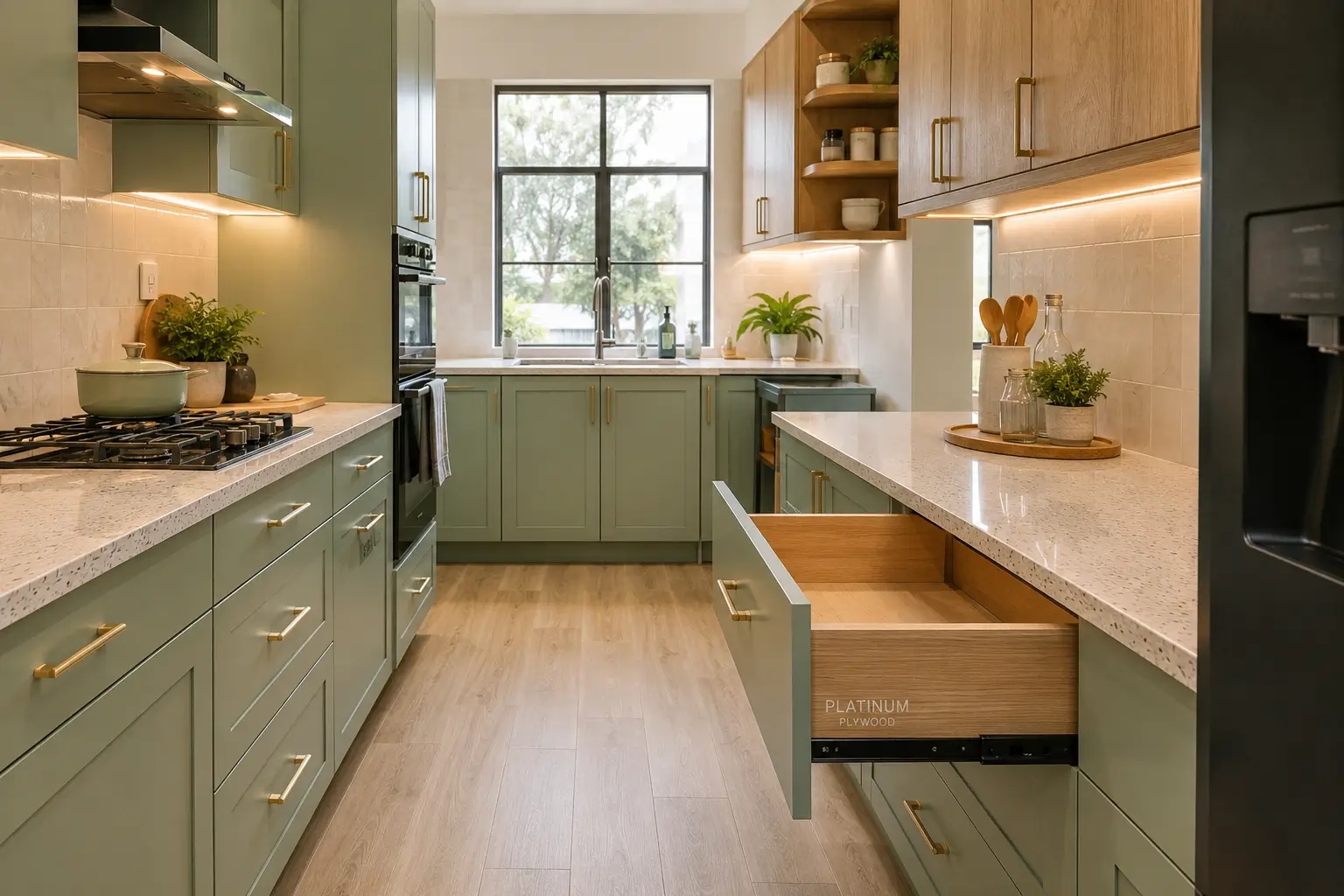
Kitchen cabinets in Kenya are exposed to a combination of conditions that differ from many other markets where cabinet materials and construction standards originate. Humidity levels in Nairobi and coastal regions, frequent handwashing of dishes without a dishwasher in most homes, charcoal or gas cooking that introduces grease and heat near upper cabinets, and the simple volume of daily use in a household kitchen all place real stress on the carcass material, the door finish, and the hardware. The best kitchen cabinet materials in Kenya are those that have been correctly matched to these conditions rather than selected on price or appearance alone.
A poorly chosen cabinet material shows its weaknesses within the first one to two years: swelling at the base cabinets near the sink, peeling laminate edges, sagging shelves under the weight of pots and crockery, or hinges pulling loose from a carcass material that was never designed to hold them securely. Understanding the available materials before committing to a kitchen renovation prevents these problems and protects the investment in the rest of the kitchen fit-out.
Strofix Tip: The carcass material, meaning the box structure of the cabinet, matters more for long-term durability than the door finish. A kitchen with a premium door finish on a poor quality carcass will fail at the joints and hinges within a few years, while a kitchen with a well specified carcass and a modest door finish will remain structurally sound for well over a decade. Always ask what carcass material is being quoted before evaluating door finishes.
The Best Kitchen Cabinet Materials in Kenya for 2026
1. Plywood
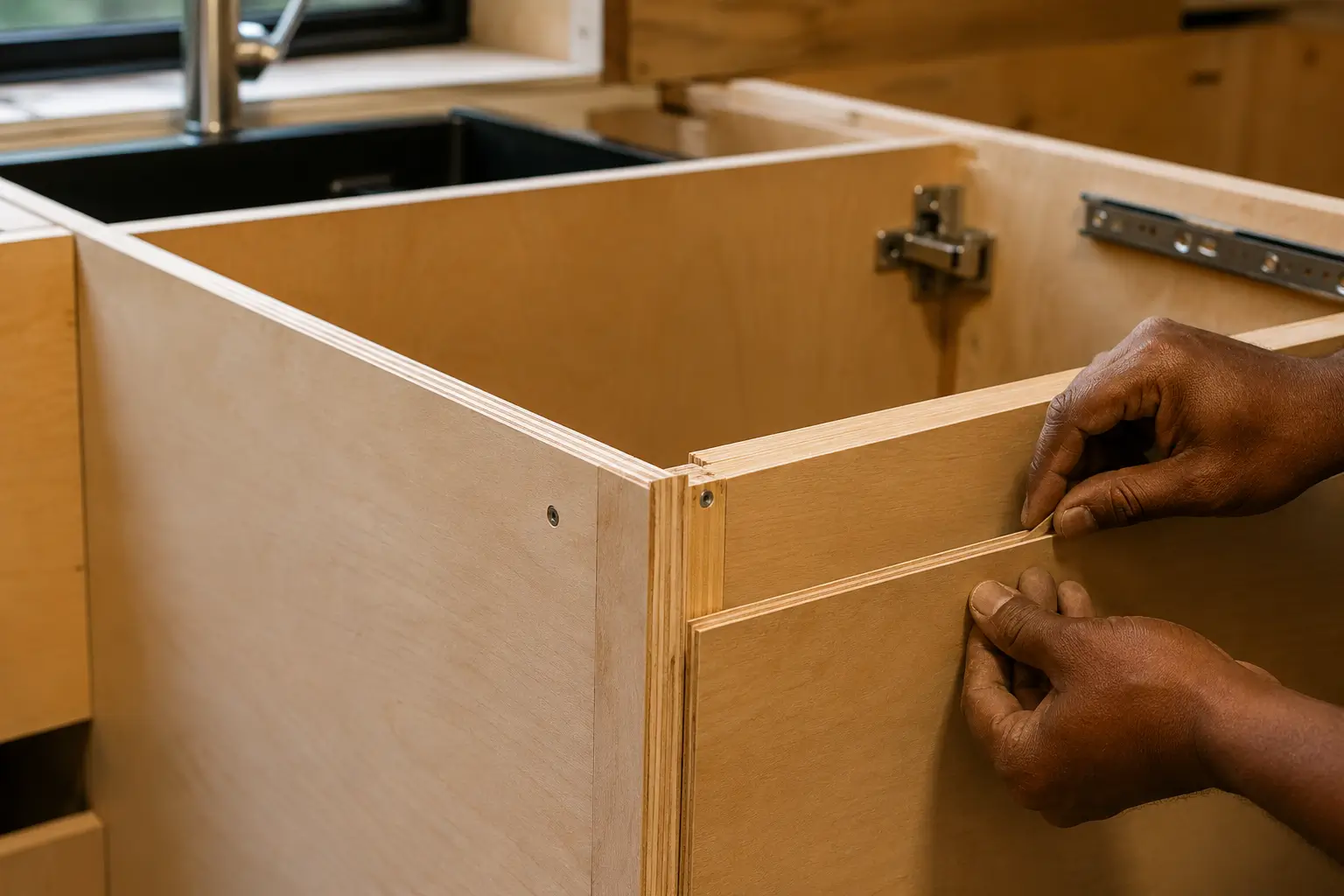
Plywood is consistently ranked among the best kitchen cabinet materials in Kenya for carcass construction, particularly for base cabinets located near the sink and dishwasher area where moisture exposure is highest. Plywood is manufactured from thin layers of wood veneer glued under pressure with the grain direction alternating between layers, which gives it strong resistance to warping and significantly better moisture tolerance than particleboard or standard MDF. Marine-grade plywood, which uses a waterproof adhesive between layers, is the preferred specification for any cabinet section that will see regular water contact.
The main consideration with plywood is cost. It is more expensive than MDF or particleboard, and the visible edges require careful finishing with edge banding or a solid timber lipping to achieve a clean appearance, since the layered structure is visible on a raw cut edge. For homeowners prioritising long-term durability over upfront cost, plywood carcasses represent one of the strongest investments in a Kenyan kitchen renovation.
2. MDF (Medium Density Fibreboard)
MDF is among the best kitchen cabinet materials in Kenya for door fronts and is frequently used for carcass construction in mid-range kitchens. It is manufactured by compressing wood fibres with resin under heat and pressure, producing a dense, smooth, and uniform panel with no visible grain. This smoothness makes MDF the preferred substrate for painted and laminate finishes, since it accepts both finishes far more evenly than plywood or solid timber.
Standard MDF is vulnerable to swelling if exposed to standing water or prolonged humidity, which makes it a less suitable choice for cabinets directly beneath the sink unless properly sealed at all edges. Moisture-resistant MDF, often referred to as MR MDF, addresses this weakness with a resin formulation that significantly improves water tolerance, and is now widely available from Kenyan board suppliers at a moderate price premium over standard MDF. For door fronts across the rest of the kitchen, away from direct water exposure, standard MDF with a properly sealed and edge-banded finish performs reliably for many years.
3. Particleboard (Chipboard)
Particleboard, also known as chipboard, is the most economical cabinet material widely available in Kenya and is commonly used in budget kitchen fit-outs and ready-made flat-pack cabinet systems. It is manufactured from wood chips and sawdust bonded with resin, producing a panel that is heavier and less dense than MDF, with lower screw-holding strength and significantly lower moisture tolerance. Particleboard is the material most likely to swell, sag, or delaminate when exposed to water, and it does not hold hinge screws as securely over years of door opening and closing.
Particleboard can be a reasonable choice for upper cabinets in dry areas of the kitchen where budget is the primary constraint, but among the best kitchen cabinet materials in Kenya it is not recommended for base cabinets, sink cabinets, or any high-moisture location. Homeowners working with a tight budget are generally better served by specifying plywood or moisture-resistant MDF for the base units, where failure is most likely and most disruptive, and using particleboard only for upper cabinets if cost savings are essential.
4. Solid Wood
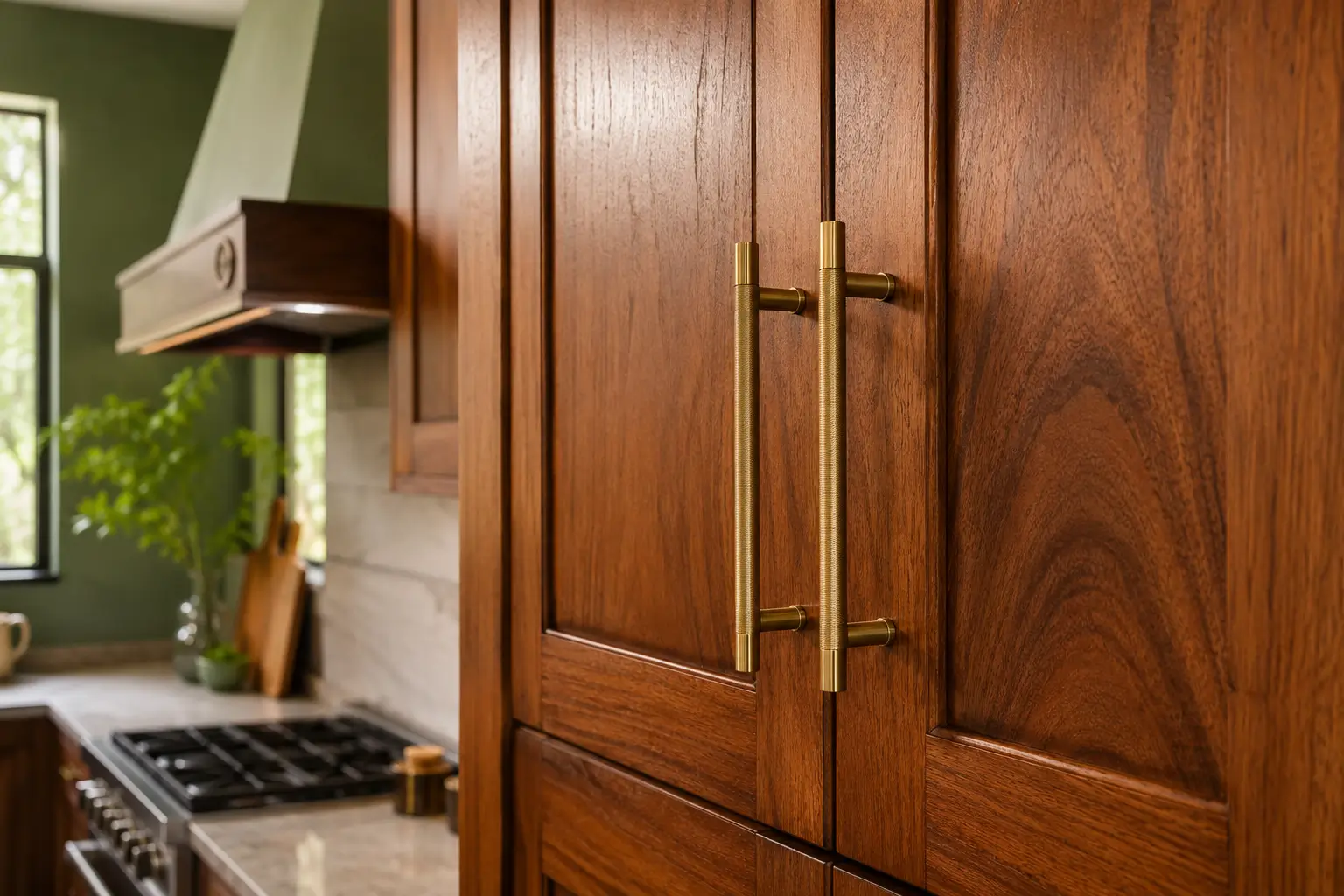
Solid wood remains among the most premium kitchen cabinet materials in Kenya, prized for its natural grain, the depth of finish achievable with staining and varnishing, and a service life that can extend several decades with proper care. When clients ask us to recommend the best kitchen cabinet materials in Kenya for a statement kitchen, solid hardwood is consistently the answer, despite its higher cost relative to engineered boards. Kenyan hardwoods including mahogany, mvule, and mninga are commonly used for solid timber cabinet doors and provide a finish that manufactured boards cannot fully replicate. Solid wood is more expensive than engineered board options and requires correct seasoning and finishing to prevent movement in response to humidity changes, since solid timber expands and contracts more than engineered panels.
For homeowners who want the authenticity of solid timber without the full cost and movement risk across an entire kitchen, a hybrid specification using solid wood for door fronts over a plywood or MDF carcass is a common and effective compromise, delivering the visual and tactile quality of solid wood where it is most visible while keeping the structural carcass in a more dimensionally stable material. The material you choose here also shapes which overall cabinet style suits your kitchen best; our guide to types of kitchen cabinet designs in Kenya covers how handleless, shaker, wood-look, and two-tone styles pair with different material specifications.
5. Laminate Finishes
Laminate is not a structural cabinet material on its own but a surface finish applied over MDF or particleboard, and among the best kitchen cabinet materials in Kenya it is one of the most popular choices for kitchen cabinet doors due to its combination of durability, low maintenance, and wide range of colour and texture options. High-pressure laminate, applied to a properly prepared MDF substrate, resists scratching, staining, and moderate heat exposure significantly better than a painted finish, and is far easier to clean than a textured timber surface, which is a genuine practical advantage in a working kitchen.
The quality of a laminate finish depends heavily on the substrate beneath it and the quality of edge sealing at every cut. Laminate over a moisture-resistant MDF substrate, with all edges properly sealed or edge-banded, performs extremely well in Kenyan kitchen conditions and represents one of the best value combinations among kitchen cabinet materials available in the local market today. To see how these finishes come together in a complete kitchen, our guide to modern kitchen designs for Kenyan homes showcases full kitchen layouts built around these same material choices.
6. Stainless Steel and Metal Accents
Stainless steel cabinetry remains uncommon as a full kitchen specification in Kenyan residential homes but is increasingly used as an accent material for open shelving, pot rails, and hardware in contemporary kitchen designs. Its primary advantage is total resistance to moisture, heat, and staining, making it the most hygienic and durable surface available for any application. Full stainless steel cabinetry is more common in commercial and restaurant kitchens across Nairobi, where hygiene standards and heavy daily use justify the higher material and fabrication cost.
Cabinet Material Comparison and Pricing in Kenya (2026)
The table below summarises the key characteristics and typical pricing of the best kitchen cabinet materials in Kenya, helping homeowners compare options directly when planning a kitchen renovation budget. Use it alongside the sections above to shortlist the best kitchen cabinet materials in Kenya for your specific household and budget.
| Material | Moisture Resistance | Typical Cost (KES per linear metre) | Best Use |
|---|---|---|---|
| Marine-grade plywood | Excellent | 28,000 – 45,000 | Base cabinets, sink units, carcass construction |
| Moisture-resistant MDF | Good | 20,000 – 32,000 | Door fronts, mid-range carcass, laminate substrate |
| Standard MDF | Fair | 16,000 – 26,000 | Upper cabinets, painted finishes, dry areas |
| Particleboard | Poor | 12,000 – 20,000 | Budget upper cabinets in dry locations |
| Solid hardwood (mahogany, mvule) | Good | 40,000 – 70,000 | Premium door fronts, statement kitchens |
| High-pressure laminate finish (over MR MDF) | Excellent | 22,000 – 35,000 | Full kitchen, high-traffic households |
How to Choose the Right Cabinet Material for Your Kenyan Kitchen
Selecting among the best kitchen cabinet materials in Kenya comes down to a short set of practical priorities rather than personal preference alone.
- Prioritise moisture resistance for base cabinets. Marine-grade plywood or moisture-resistant MDF should always be specified for cabinets beneath the sink and dishwasher, regardless of the budget allocated to the rest of the kitchen.
- Match the door finish to your maintenance preference. Laminate finishes require the least maintenance and resist daily wear best. Solid wood and painted finishes deliver the strongest visual impact but require more careful cleaning and occasional refinishing.
- Consider edge sealing as carefully as the material itself. Even the best kitchen cabinet materials in Kenya will fail prematurely if cut edges are not properly sealed or edge-banded, since exposed edges are the primary entry point for moisture damage.
- Balance imported and locally sourced boards. Both imported and Kenyan-manufactured boards are available across all material categories, and the right choice depends on specification and budget rather than origin alone. Our guide to local vs imported materials in Kenya breaks down where each option performs best across finishing categories including cabinet boards.
- Confirm hardware quality alongside the board material. Soft-close hinges and full-extension drawer runners rated for daily Kenyan kitchen use protect the cabinet material from the stress of repeated slamming and overloading, extending the service life of even a modest board specification.
How Strofix Interiors Specifies Kitchen Cabinet Materials in Kenya
At Strofix Interiors, every kitchen cabinet project begins with a site assessment of moisture exposure, usage patterns, and budget before any material is recommended. Because we work with the best kitchen cabinet materials in Kenya across every price tier, we are able to match the right specification to each client’s needs rather than defaulting to a single standard board. We specify marine-grade plywood or moisture-resistant MDF for all base and sink cabinets as standard practice, and offer a full range of door finishes from high-pressure laminate to solid hardwood depending on the client’s preference and budget. For the complete scope of our kitchen cabinet design and installation service, visit our Kitchen Cabinet Design & Installation page.
Our cabinetry work is delivered as part of our broader custom furniture design and installation service, ensuring that kitchen cabinets, wardrobes, and other built-in joinery across a home share consistent material quality and finishing standards. If you are still deciding on a cabinet style, our guides to types of kitchen cabinet designs in Kenya and modern kitchen designs for Kenyan homes are a useful next step before finalising your material specification. For a complete overview of every interior design service we offer across Nairobi and Kenya, visit our interior design services in Kenya page, and for detailed pricing across all rooms and finishes, see our cost of interior design in Kenya guide.
Ready to Plan Your Kitchen Cabinets?
Get a detailed quotation from Strofix Interiors. We specify the best kitchen cabinet materials in Kenya for your specific kitchen, budget, and household needs, with full installation across Nairobi and Kenya.
FAQs: Best Kitchen Cabinet Materials in Kenya
What are the best kitchen cabinet materials in Kenya?
The best kitchen cabinet materials in Kenya for carcass construction are marine-grade plywood and moisture-resistant MDF, due to their strong resistance to humidity and water exposure near sinks and dishwashers. For door finishes, high-pressure laminate offers the best combination of durability and low maintenance, while solid hardwood remains the premium choice for homeowners prioritising natural appearance over cost.
Is plywood or MDF better for kitchen cabinets in Kenya?
Plywood offers superior moisture resistance and screw-holding strength, making it the stronger choice for base cabinets and sink units in a Kenyan kitchen. MDF is smoother and more cost-effective, making it the preferred substrate for painted or laminate door finishes in areas away from direct water exposure. Many Kenyan kitchens use a combination of both, with plywood for the carcass and MDF for door fronts.
How much do kitchen cabinets cost in Kenya?
Kitchen cabinet costs in Kenya range from approximately KES 12,000 to KES 70,000 per linear metre depending on the material specified, with particleboard at the lower end and solid hardwood at the upper end. A mid-range specification using moisture-resistant MDF carcasses with a laminate finish typically falls between KES 20,000 and KES 35,000 per linear metre. Contact Strofix Interiors for a detailed quotation based on your kitchen layout and material preference.
What cabinet material resists moisture best in a Kenyan kitchen?
Marine-grade plywood and high-pressure laminate over moisture-resistant MDF both offer excellent moisture resistance and are the recommended choices for base cabinets and sink units. Standard particleboard and untreated MDF should be avoided in any cabinet location with regular water exposure, as both are prone to swelling and delamination over time.
Should I choose local or imported cabinet boards in Kenya?
Both local and imported cabinet boards are widely available across Kenya and can deliver excellent results when correctly specified. The right choice depends on the specific material grade and finish quality rather than origin alone. Our local vs imported materials guide covers this comparison in detail across cabinet boards and other finishing categories.
How long do kitchen cabinets last in Kenya?
Kitchen cabinets built from marine-grade plywood or moisture-resistant MDF with quality hardware typically last fifteen to twenty-five years with proper care. Solid hardwood cabinets can last several decades when correctly finished and maintained. Cabinets built from untreated particleboard in moisture-prone areas often show signs of damage within two to five years and have a significantly shorter service life.